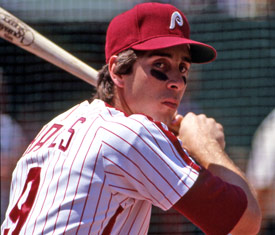
When a hitter takes a free pass, he walks - or runs, in the case of Brandon Nimmo - 90 feet to first base. When I decided to pass through the city freely, traveling on foot to various sites of former and current ballparks to raise money for the American Cancer Society, I walked 64 miles, or 337,920 feet.
This two-day journey through all five boroughs took me to major league stadiums (Citi Field and Yankee Stadium), minor league parks (MCU Park and Richmond County Bank Ballpark at St. George) and several sites where professional baseball used to be played. If you followed along on Facebook and Twitter while I was shuffling my feet, you saw me post short videos at each location. If you didn't, that's where this blog post comes in. Think of it as the Cliff's Notes to my walking tour of New York baseball history.
 |
This place is a part of my past, present and future. (Photo by Ed Leyro/Studious Metsimus)
|
The walk began on Friday, October 9, at Heritage Field in the Bronx. This is where old Yankee Stadium used to stand from 1923 to 2008. The field, which has not been well maintained during the current global pandemic, is where Babe Ruth, Lou Gehrig, Joe DiMaggio, Mickey Mantle and the recently departed Whitey Ford established themselves as baseball legends.
There is not much left from the original Yankee Stadium in this area other than the large bat that used to stand outside the House That Ruth Built and a piece of the iconic frieze, which was originally above the upper deck of the old ballpark. That frieze is now located by a running track located in the approximate area where the center field wall at the old Yankee Stadium once stood.
 |
Batman vs. Mr. Freeze? No, it's just a bat and a frieze. (EL/SM)
|
From Heritage Field, I crossed E. 161 St. to the new Yankee Stadium, which opened for business in 2009. Despite it being the closest major league stadium to where I live, I have never set foot inside the new stadium, and I'm okay with that. Besides, I'd probably look just like this in all my photos if I ever entered the ballpark.
 |
Doing my best Siskel & Ebert reviewing "Ishtar" pose. (EL/SM)
|
The Yankees weren't always known by that moniker. In fact, they weren't always a New York team. In 1901 and 1902, the franchise played in Baltimore as the original Orioles, then they moved to Manhattan and became the New York Highlanders. The Highlanders took that name because they played their home games in American League Park, which was better known as Hilltop Park because it sat atop a hill in Washington Heights. That was the future Yankees' home for ten seasons (1903-12) before their lease expired. They then left the park and the Highlanders name to move to the Polo Grounds and play as the New York Yankees.
Hilltop Park was demolished in 1913, but over a century later, there is still one reminder that a ballpark once rose atop the hill.
After I crossed Macombs Dam Bridge into Manhattan, I made my way to Fort Washington Avenue between W. 165 St. and W. 168 St. This is the current location of the New York Presbyterian / Columbia University Irving Medical Center. On the east side of Fort Washington Avenue, just north of W. 165 St. is a set of two gates that lead to a garden and chapel. These gates are usually locked from the outside, but as one person left the gate furthest away from W. 165 St., I took advantage and went in before the gate locked shut. Walking to the back of the garden across from the chapel, I found a plate-shaped plaque that was dedicated on the exact spot where Hilltop Park's home plate was once located. It's a shame that it's not easily accessible to the public, but as long as you don't mind sneaking in - the garden is technically a public space even though it's behind a locked gate - the Hilltop Park artifact is there for the viewing.
 |
Behind a locked gate, this home plate is definitely safe. (EL/SM)
|
When the Highlanders moved to the Polo Grounds in 1913 and became the Yankees, they shared their new home with their National League counterparts, the New York Giants. The Giants had only been in existence for a little over a quarter century, but they already had quite a history with their home ballparks. In fact, their home in 1913 was the fourth such edifice known as the Polo Grounds.
The original Polo Grounds was built in 1876 and was located between Fifth and Sixth Avenues from 110th to 112th Streets, just north of Central Park. Polo was originally played there before the original New York Metropolitans called it home from 1880 to 1885. The Metropolitans, who played in the American Association, shared Polo Grounds I with the National League's New York Gothams, who began play in 1883. Two years later, the Gothams became the Giants.
In 1886, the Giants no longer had to share a stadium with the original "Mets", as the Metropolitans baseball club left polo for cricket, vacating the Polo Grounds to move into their new home in Staten Island at the St. George Cricket Grounds, where they played for two seasons until the team ceased operations. The Giants' residence at Polo Grounds I ended after the 1888 season, when the city of New York decided they wanted to extend the Manhattan street grid north of 110th St. Needing a new home, the Giants played two games at Oakland Park in Jersey City, NJ before temporarily moving to the St. George Cricket Grounds. While they played in Staten Island for two months, a new Polo Grounds was being erected under Coogan's Bluff in upper Manhattan. That ballpark opened in the summer of 1889.
Polo Grounds II was not the only park in the area. Just two blocks south was a ballpark that housed another baseball team known as the New York Giants. Those Giants were part of the Players' League and they played in Brotherhood Park in 1890. When the rival Players' League folded after just one season, the National League's New York Giants moved into Brotherhood Park in 1891 and renamed it - you guessed it - the Polo Grounds, the third such park with that name.
The third Polo Grounds was built out of wood, which as we all know is quite flammable. Sure enough, in April 1911, Polo Grounds III was destroyed by a fire, forcing the Giants to relocate to Hilltop Park for two months while a new Polo Grounds was being built on the same location as the burned down building. Learning from the past, Polo Grounds IV was built out of steel and concrete, allowing it to survive everything except a demolition ball, which was used after the second iteration of the Mets left for Shea Stadium in 1964.
In over half a century, Polo Grounds IV housed the Giants (1911-57), Yankees (1913-22) and Mets (1962-63). The site now houses the Polo Grounds Towers, an apartment complex that overlooks the Harlem River. There are still several reminders that baseball was once played there, including a new Polo Grounds Towers sign that's painted in the old New York Giants' colors and the John T. Brush Stairway, which used to lead fans down Coogan's Bluff into the Polo Grounds.
 |
Also the first home of the New York Mets. (EL/SM)
|
The Yankees and Giants were just two of the three major league teams that called New York home prior to the formation of the Mets in 1962. Brooklyn once had a team as well, but they weren't always called the Dodgers.
From 1883 to 1891, the Brooklyn Atlantics, Brooklyn Grays, Brooklyn Bridegrooms and Brooklyn Grooms played at the first Washington Park in the neighborhood of Park Slope. This ballpark was located between Fourth and Fifth Avenues from 3rd to 5th Streets. Currently, a public park with that name can be found where Brooklyn's first National League team once played. After leaving Washington Park in 1892, the team moved to Eastern Park in Brownsville. But when fans failed to follow the team to their new digs in Brownsville, the club moved back to a new Washington Park after the 1897 season, located just a block away from the original ballpark.
This park, in the Gowanus neighborhood of Brooklyn, was home to the team with many names, as they were known as the Bridegrooms in 1898 and the Superbas from 1899 to 1910 before finally setting on the Dodgers in 1911 after the people who dodged the trolleys in the vicinity of Washington Park. Brooklyn played at this Washington Park for fifteen seasons (1898-1912) before moving to Ebbets Field in 1913.
Washington Park might not be standing anymore, but the building's wall still is. A short 12-mile walk from the Polo Grounds Towers, on the corner of Third Avenue and 1st St. in Gowanus, is a wall that looks exactly like what you'd expect a late 19th century/early 20th century ballpark wall to look like. The brick wall that was behind center field runs for part of 1st St., while the wall that stood behind the left field area of the park takes up all of Third Ave. from 1st St. to 3rd St. The photos below show what that exterior wall of Washington Park looked like.
 |
Washington Park wall. (EL/SM)
|
Once the Dodgers left Washington Park for the new Ebbets Field in 1913, they became the Superbas once again before taking the new name of the Brooklyn Robins in 1914. That name stuck for nearly two decades until they finally settled on the Dodgers for good in 1932. The Dodgers played at Ebbets Field for another quarter century before failed attempts at a new ballpark in Brooklyn or Queens caused the team to move to Los Angeles, taking the Giants with them to the Golden State.
The location of Ebbets Field in Crown Heights (the area was part of Flatbush when the Dodgers called it home) is now covered with apartment buildings. Similar to the Polo Grounds Towers in Manhattan, the Ebbets Field Apartments (also known as the Jackie Robinson Apartments) rest on the location of a former major league ballpark. This apartment complex also remembers its history, with a cornerstone on Bedford Ave. that notes what used to stand there and a home plate marker just outside a laundromat within the complex, which can be seen by walking into a nondescript entrance on Sullivan Place. (The former address of Ebbets Field was 55 Sullivan Place.)
 |
The site of the House That Jackie Built. (EL/SM)
|
Before the Dodgers settled on moving to the west coast, one of the areas they were looking at for a new stadium was in Queens. And seven years after Brooklyn got out of Dodge, Queens had its own team when Shea Stadium opened to Mets fans in 1964.
The Mets became New York's one and only National League team in 1962, setting up shop at Polo Grounds IV for two seasons while they waited for Shea Stadium to be completed. Once they moved to Flushing, the Mets stayed at Shea for 45 seasons - the same number of years Ebbets Field hosted the Dodgers/Superbas/Robins - before moving across the parking lot to Citi Field in 2009.
By the time I walked the ten miles from the site of Ebbets Field to the former home of Shea Stadium, the sun had set on my first day of walking, so I ran the Shea Stadium bases, which are conveniently marked in the current Citi Field parking lot, before taking one last photo with my Studious Metsimus colleagues outside the Jackie Robinson Rotunda entrance at Citi Field.
 |
Time for bed. There's still another day of walking to go! (EL/SM)
|
Day two of my baseball walk (Saturday, October 10) began where the first day ended - at Citi Field. Although the sun had not officially risen when I got there, there was enough daylight to take photos of the area where Shea Stadium used to be and the special purple and back bunting above the Seaver Entrance, which was named after the late Tom Seaver.
 |
May "The Franchise" rest in peace. (EL/SM)
|
With the major league parks out of the way, it was now time to go back to the minors. From Queens, I walked over the Kosciuszko Bridge to Brooklyn, made my way through Greenpoint and Wiliamsburg, then scampered over the Williamsburg Bridge to Manhattan. Once in Manhattan, I made my way south through Chinatown and the Financial District before arriving at the Staten Island Ferry terminal. Since it's not possible to walk to Staten Island from another borough, I got on the ferry and walked around the boat as I made the 25-minute trip through New York Harbor. Once the ferry docked at the St. George terminal, I walked a short distance to the next stop: Richmond County Bank Ballpark at St. George, a.k.a. the home of the Staten Island Yankees.
The Staten Island Yankees have played in the New York-Penn League since 1999. In their first two seasons, they played their home games at the College of Staten Island Baseball Complex before moving into their current home in St. George. The parking lot of RCB Ballpark is also home to a bit of baseball history, as that was the former location of the St. George Cricket Grounds, where the original New York Metropolitans and New York Giants played in the 1880s.
The ballpark in Staten Island has several unique features, such as the likeness of the Verrazzano Bridge above the video board in left field, a panoramic view of the Lower Manhattan skyline, and a Wall of Fame dedicated not to former players, but to the baseball scouts who discovered some of the best players. If only that Wall of Fame wasn't located behind the first base stands, invisible to mostly everyone in the stadium.
 |
Seriously, couldn't this have been located where it could be, you know, seen? (EL/SM)
|
From Staten Island, it was back on the ferry to Manhattan, followed by a walk north to the Manhattan Bridge, which I crossed to get back into Brooklyn. On my way to the final destination of this two-day baseball trip, I made a stop at Barclays Center. Why did I stop at a place that was built for basketball, hockey and non-sports events? Because it is also the home of a piece of Brooklyn Dodgers history.
Outside the arena, on the corner of Atlantic Ave. and Flatbush Ave., is a lone flagpole. But this is not just any flagpole. No, my friends, this pole once flew at Ebbets Field and was brought to Barclays Center in 2012 to commemorate the return of professional, major league sports to Brooklyn. (The NBA's Nets have called Barclays Center home since 2012, while the NHL's Islanders played there from 2015-19.)
 |
O say, does that Ebbets Field banner yet wave? Yes. Yes, it does. (EL/SM)
|
I had already walked over 50 miles between the two days. I had visited two current MLB stadiums, the sites of several former major league parks and had even seen some artifacts from those current and former parks that are still standing. I had just one stop to go. And to do so, I had to walk as far south as I could go on foot in Brooklyn. I had to go to Coney Island.
By this time, I was walking at a Bartolo Colón home run trot pace. But I was determined to make it to my final destination. I walked eight miles through the neighborhoods of Park Slope, Windsor Terrace, Kensington, Borough Park, Midwood and Gravesend, with no other baseball sites to slow me down. And right before sunset, I finally made it to Coney Island. Once there, I passed by Luna Park. I also passed by Nathan's. I did not pass by MCU Park, which was the end of my journey.
Once the Brooklyn Dodgers left for California after the 1957 season, the borough of Kings was left without professional baseball for 44 years. It wasn't until the Cyclones came to town in 2001 that Brooklyn had a team again.
The Cyclones started in St. Catharines, Ontatrio, as a minor league affiliate of the Toronto Blue Jays. They played in Canada from 1986 to 1999, before moving to Queens in 2000 as the Queens Kings. Although they played in Mets country, they were still the New York-Penn League affiliate of the Blue Jays. Finally, in 2001, and nearly half a century after the Brooklyn Dodgers considered building a new home in Queens, the Kings moved from Queens to Brooklyn, setting up shop at KeySpan Park in Coney Island, which was renamed MCU Park in 2010.
Brooklyn had a professional baseball team again and this bum was done with his walk.
 |
Forgive the blurriness. It was late and I was tired. (EL/SM)
|
In just two days, I covered 64 miles walking through all five boroughs and saw more New York baseball history than I ever thought I could. But most importantly, I helped raise $2,100.00 for the American Cancer Society.
This was a 36-hour period I will never forget and one my feet will probably never forgive me for. But I certainly hope they'll get over it. After all, it was a baseball trip. And taking a walk is always good for the team.
 |
A walk is as good as a hit. In this case, my walk was a hit. (EL/SM)
|